The Right Hole for the Job: Leather Hole Sizes Explained
A rivet that sits flat, a belt prong that slides in easily, a seam that pulls tight: each needs a different hole. Leather hole sizes, and how to choose them.
There is a small satisfaction in pressing a rivet into a hole and feeling it seat with no play, or in buckling a belt you made and finding that the prong slides in exactly as it should. Those moments come from one decision taken earlier: the size of the hole. Too large, and hardware wobbles and wears the leather around it; too small, and posts have to be forced, the leather stretches, and thin edges can split. Getting leather hole sizes right is less about memorising a chart than about knowing what goes through each hole and measuring it.
This article explains how to choose a hole size for stitching, rivets, snaps, Chicago screws, eyelets and belt buckles, how to measure hardware rather than trusting a label, and why a test on a scrap of the same leather is always worth the minute it takes. It is part of our guide on how to punch holes in leather, which covers tools and technique more broadly.
Measure what goes through the hole
Hole sizes are usually given as diameters in millimetres, sometimes as fractions of an inch, and sometimes, for rotary and drive punches, as numbers that differ between manufacturers. Because those numbers are not consistent, the most reliable approach is to measure the thing that will go through the hole: the post of a rivet, the stud of a snap, the barrel of a Chicago screw, the prong of a buckle, or, for stitching, the needle and thread.
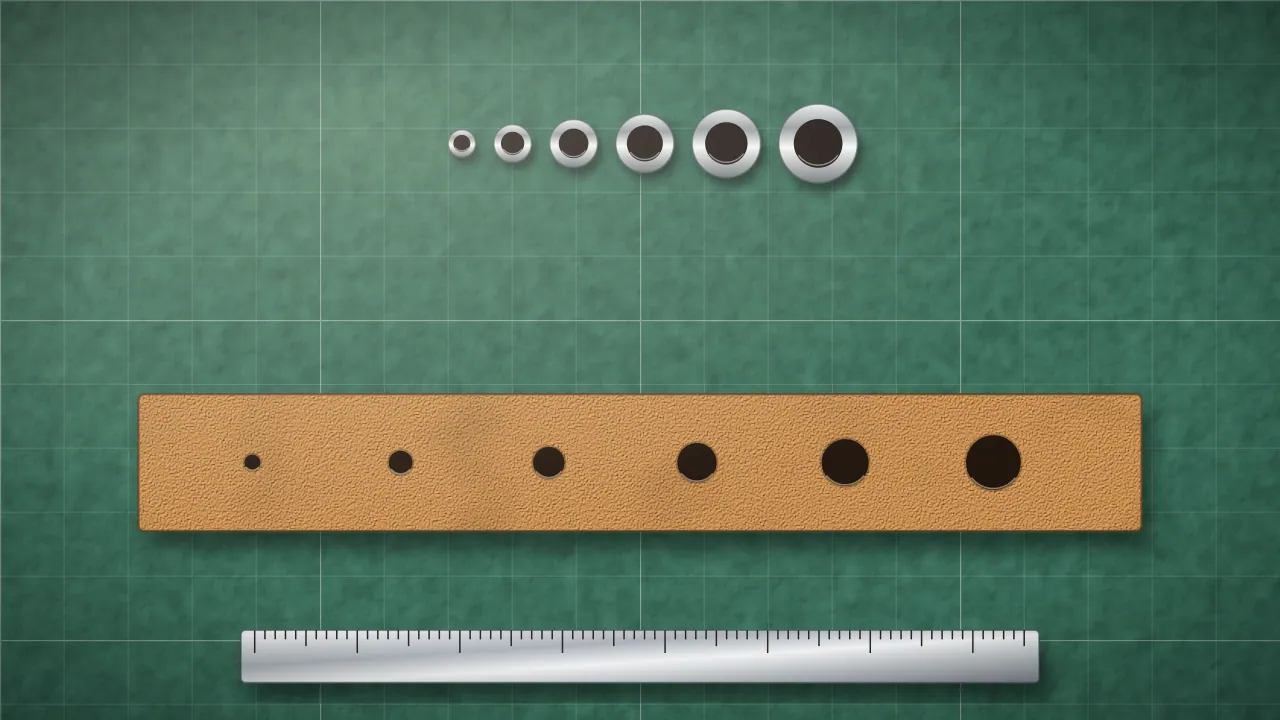
A pair of calipers makes this easy and is one of the most useful inexpensive tools you can own. If you do not have calipers, compare the hardware against your punch tips directly: hold the post against the end of each tip and choose the one whose cutting edge matches the post or is a hair smaller. Leather has some give, so a hole fractionally smaller than a post usually grips it well, while a hole that is larger lets it move.
Remember that hand tools have small tolerances. A tip sold as 3 mm may cut a hole slightly larger or smaller, and the same tip cuts differently in thin soft leather and thick firm leather. This is true of every punch: the hole a tip actually cuts can differ from its marked size by a few tenths of a millimetre. A test hole in an offcut tells you what the tip actually does in the leather you are using.
Holes for stitching
Most hand stitching runs through slits or diamonds made by pricking irons or chisels, but round holes are a valid alternative and give a straighter, more upright stitch line. For round stitching holes, the hole needs to let the needle through and hold two passes of thread snugly. On small goods with fine thread, a small tip, such as 1.5 mm, often works well; thicker thread and thicker leather may call for a slightly larger hole.
The right size is the smallest that lets both passes of thread through without forcing. Too large a hole and the stitches look loose, the thread can sit crookedly, and the seam loses some of its neatness; too small and the thread frays as you pull it through, or the needle is hard to push. A short test seam of five or six stitches on an offcut tells you more than any rule.
Round holes and slits each give a recognisable look, and the choice between them is partly a matter of taste. Our article on round holes or slits for hand stitching compares the two in detail, including spacing and how each affects the slant of the stitches. Whichever you choose, the spacing between holes matters as much as their size.
Holes for rivets, snaps, screws and eyelets
Hardware is the case where measuring matters most. For a rivet, the hole should match the diameter of the post, which passes through the leather and into the cap; post length is a separate question, which depends on the combined thickness of the layers, as explained in setting rivets in leather. Snaps have a post on the cap and a stud on the socket side, which may need slightly different holes; check both parts and size each hole to its own part.
Chicago screws, which can be undone and done up again, need a hole matching the barrel of the screw. A snug hole stops the screw from rotating and loosening in use; Chicago screws in leather covers sizes and fitting. Eyelets and grommets need a hole matching the outside diameter of their barrel, so the barrel passes through and can be rolled over by the setter without tearing the leather.
When you buy hardware, keep a note of the hole size that worked for each type, perhaps written on the bag or in a notebook. It saves you from measuring again next time, and you will quickly build your own chart, based on your leathers and your tools, which is more reliable than any generic one.
Holes for belts and buckles
A belt hole has to let the buckle prong in easily, every day, for years, without tearing. Prongs vary in thickness and shape, so again the most reliable guide is to measure the prong and choose a hole slightly larger than it, so it can slide in and out without catching. Many belt holes are round; others are oblong slots, made with an oblong punch, which give the prong a little room to move as the belt flexes.
The spacing of belt holes and the placement of the middle hole are a separate question, covered in belt hole spacing and placement. If you are adding a hole to an existing belt rather than making a new one, copy the size and spacing of the holes already there, as described in how to add a hole to a belt. A new hole that matches the others looks original; a mismatched one draws the eye.
Belt leather is usually thicker and firmer than leather for small goods, which affects which punch works well. A press punch suits leather up to the thickness it was designed for; thick belt leather often calls for a drive punch struck with a mallet, or a heavy rotary punch.
Test, adjust and keep notes
Every leather behaves differently. A soft, chrome-tanned leather closes up slightly around a hole, so the hole looks smaller than the tip; a firm vegetable-tanned leather keeps the exact size of the tip. Thicker leather may also give a hole slightly narrower at the bottom than at the top. That is why the most useful habit with hole sizes is simply to punch a test hole in an offcut of the same leather, fit the hardware or the thread through it, and adjust if needed.
A test also checks the tool. If the test hole is torn or fuzzy rather than clean, the tip may need cleaning or sharpening, or the surface underneath may be too soft. Our article on why holes come out ragged goes through the common causes. Correcting them on a scrap is much better than discovering them on the finished piece.
Finally, keep your tips organised by size. Tips that roll around a drawer are easy to confuse, especially those only half a millimetre apart. A small box with labelled compartments, or the storage box that comes with a set of tips, makes it quick to find the right one and to put it back.
Choosing sizes with confidence
Leather hole sizes come down to one principle: measure what goes through the hole, choose a tip that matches it or is slightly smaller for hardware and slightly larger for buckle prongs, and test on the same leather before the real piece. Stitching holes should be the smallest that lets two passes of thread through comfortably.
With a set of tips covering the common small sizes, most projects are within reach: stitching holes, rivets, snaps and belt holes for thinner straps. For the wider picture of tools and technique, return to how to punch holes in leather, and if you are looking for tips in these common sizes, our six-tip hole punch covers about 1.5 to 4 mm.
Questions people ask
What size hole do I need for a rivet in leather?
Match the diameter of the rivet's post, measured with calipers or held against the punch tips. A hole equal to the post or a hair smaller grips it without play. Post length is a separate choice that depends on the thickness of the leather layers the rivet joins.
What hole size is used for hand stitching leather?
For round stitching holes, choose the smallest size that lets the needle and two passes of thread through without forcing. With fine thread on small goods, a small tip such as 1.5 mm often works; thicker thread or leather may need slightly more. Test a short seam on an offcut first.
How big should belt holes be?
Slightly larger than the buckle prong, so it slides in and out easily without catching. Measure the prong rather than relying on a chart, since prongs vary. Many belts use round holes; oblong slots give the prong a little room to move as the belt flexes.
Why is my punched hole smaller than the punch tip?
Soft leathers close up slightly around a hole after punching, and thick leathers can give a hole slightly narrower at the bottom. Hand tools also vary a little from their stated size. A test hole in the same leather shows the real result before you commit.
Are punch numbers the same between brands?
Not always. Rotary and drive punches are often labelled with numbers that do not mean the same diameter from one manufacturer to another. Millimetre sizes are more reliable, and measuring the hardware and testing on a scrap is the safest approach.