Clean Holes, Calm Hands: How to Punch Holes in Leather
Neat holes are where a good seam, a belt that fits and hardware that sits flat all begin. The tools, the sizes and the gestures for punching holes in leather.
Look closely at a piece of leatherwork you admire and you will notice the holes before you notice anything else: a row of stitches marching evenly along an edge, a belt hole that sits exactly where the buckle wants it, a rivet that lies flat without a gap around it. Holes are rarely the part of a project people get excited about, yet they decide how the finished piece looks and how long it lasts. The pleasant surprise is that learning how to punch holes in leather cleanly is mostly a matter of choosing the right tool, marking well and keeping the punch straight. This guide brings together everything around holes, from sizes and tools to belts, straps and hardware, and links to a detailed article for each situation as it comes out.
Why the holes decide how a piece looks
A seam is only as straight as the holes it runs through. If the holes wander, the thread follows them, and no amount of care with the needle can hide it afterwards. The same goes for spacing: holes that are a little closer here and a little further there give stitches of different lengths, which the eye picks up at once. For hardware the stakes are practical rather than visual. A hole that is too large lets a rivet or a snap move and wear the leather; one that is too small forces the post through, stretches the leather and can split a thin edge.
This is also why it pays to slow down at this stage. Cutting a piece takes a few minutes, stitching it may take an hour, but the holes connect the two, and they cannot be moved once made. A few minutes spent marking positions carefully, testing the size on a scrap and checking that the punch is vertical save you from the most visible mistakes. If your holes have tended to come out torn or fuzzy, why holes come out ragged, and how to get clean ones goes through the usual causes, from a dull tip to a soft surface underneath.
The kinds of holes, and what each one is for
Leatherwork uses a few distinct kinds of holes. Round holes take hardware such as rivets, snaps, eyelets and Chicago screws, and they make the holes of most belts and straps. Stitching holes are often small slits or diamonds made by pricking irons or stitching chisels, which give the familiar slanted look of a hand-sewn seam; small round holes can be used for stitching too, giving a straighter, more upright line, as explained in round holes or slits for hand stitching. Oblong slots, made with a dedicated oblong punch, are traditional on belts because the buckle prong moves inside them.
Each use calls for a different size. A rivet or a snap needs a hole matching its post, a belt needs a hole a little larger than its prong, and a stitching hole needs to let two passes of thread through without being loose. Our article on leather hole sizes gathers these needs in one place and explains how to measure hardware rather than relying on a number printed on a packet. Before you punch anything, the position matters as much as the size; marking hole positions on leather covers rulers, wheels and dividers.
Choosing a punch that suits your hands
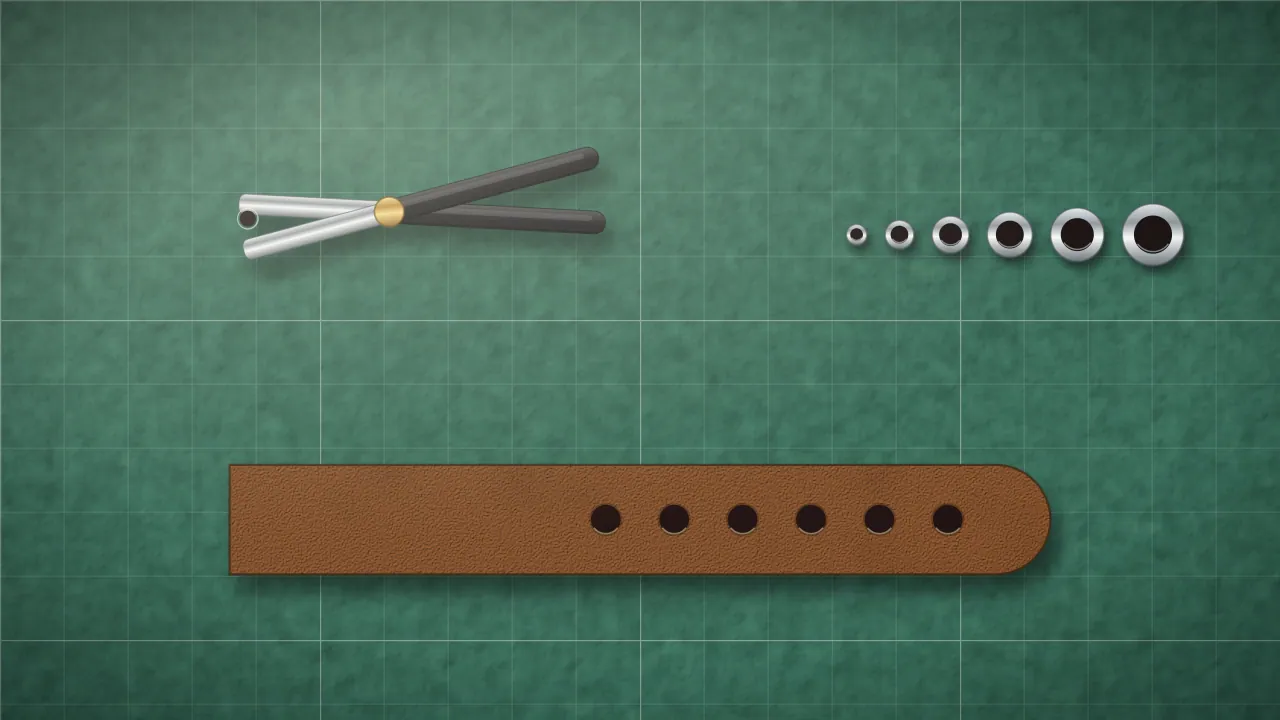
There are four common families of hole punch. Rotary punches look like pliers with a wheel of tubes; they are quick for belts and straps near an edge but cannot reach far into a piece. Drive punches are single tubes struck with a mallet on a hard board; they reach anywhere and cope with thick leather, at the cost of noise and a little practice. Prong punches and pricking irons, also struck, make whole rows of stitching holes at once. Press punches cut by pressure from your hand, which makes them quiet and easy to control on leather of moderate thickness.
The comparison in types of leather hole punch goes through the strengths and limits of each. If you work in a flat, share walls with neighbours or simply prefer a calmer bench, punching leather without a mallet looks at the quieter options. Press punches with interchangeable tips let one tool cover several sizes: you screw in a tip and press straight down. They suit small goods and lighter straps; for very thick belt leather, a drive punch and a mallet are often the better tool, and punching thick and thin leather explains why.
Whatever the tool, it only cuts cleanly while its edge is sharp and clean. Leather fibres, wax and dye build up inside a tube over time, and a plug of leather left in the tip pushes against the next one instead of letting it through. Clear the plugs regularly, wipe the tips after use and store them dry so they do not mark or rust. When a tip starts to crush the leather rather than cut it, a few gentle turns against fine abrasive paper on its outer bevel, or inside with a rolled strip, usually brings it back. A punch looked after this way stays pleasant to use for years, and the same care applies to every cutting tool on the bench.
Holes in the things you wear: belts and watch straps
Most people first pick up a hole punch for something they own rather than something they make: a belt that is almost right, a watch strap that sits between two holes. These small repairs are worth doing well, because the new hole will be seen and used every day. The key is to copy what is already there: the same size as the existing holes, on the same centre line, at the same spacing. How to add a hole to a belt walks through measuring, marking and punching so the new hole looks original.
If you are making a belt rather than adjusting one, spacing becomes a design decision: how many holes, how far apart, and where the middle one falls relative to the buckle. Belt hole spacing and placement explains how to measure the wearer and lay the holes out. Watch straps are smaller and less forgiving, since the leather is thinner and the holes are close together; adding a hole to a leather watch strap covers the extra care they need, including when it is wiser to leave the job to a watchmaker.
Holes for hardware, and materials other than leather
Hardware turns a flat piece into something that closes, hangs or holds. Rivets join layers permanently and are set with a setter and a mallet once the hole is made; setting rivets in leather explains how to choose the post length and size the hole. Chicago screws do a similar job but can be undone, which is handy for straps and interchangeable parts, as described in Chicago screws in leather. Snaps and eyelets each have their own setting tools; fitting snaps and eyelets in leather covers the holes they need and the order of the parts.
Hole punches are not only used on leather. Faux leather, felt, cork fabric and thin rubber are punched for crafts, cosplay and repairs, and each behaves differently: some materials tear, some close up around the hole, some leave a fuzzy edge. Punching faux leather, felt, cork and rubber collects what works on each. Whatever the material, test on an offcut first; a single trial hole tells you more than any chart.
Where to go from here
Good holes come from three things: the right size for the job, a careful mark, and a punch held straight on a firm surface. Choose a tool that suits the leather you use and the noise you can make, practise a row of holes on scrap before the real piece, and keep your tips clean and sharp. Everything else, from stitching to hardware, becomes easier once the holes are right.
If your next step is the seam itself, continue with a guide to hand stitching leather. If you are just setting up, how to start leathercraft shows where punching fits among the other stages. And if you are looking for a press punch, our six-tip hole punch has tips from about 1.5 to 4 mm, for leather up to around 4 mm thick.
Questions people ask
What is the easiest way to punch holes in leather?
For most small projects, a press punch or a rotary punch is the simplest start, because neither needs a mallet. Mark the position, choose the right tip size, hold the punch vertical and press firmly on a stable surface. For thick leather or holes far from an edge, a drive punch and a mallet often work better.
What surface should I punch leather on?
Use a firm surface that the tip can cut into slightly without being damaged: a polyethylene cutting board, a self-healing mat over a hard table, or a block of hard rubber. Punching directly on stone or metal dulls the tip, while a soft surface lets the leather stretch and gives ragged holes.
How do I know which hole size to use?
Measure what goes through the hole. For a rivet, snap or screw, match the diameter of its post; for a belt, choose a hole slightly larger than the buckle prong; for stitching, the hole only needs to let the needle and two passes of thread through. Always test on a scrap of the same leather.
Can I punch holes in leather without special tools?
You can make a hole with an awl or a sharp leather knife, but it will rarely be as round and clean as a punched one. For anything that will be seen or that holds hardware, a proper punch is worth having. Even an inexpensive punch with a few sizes covers most small projects.
Why does my punch leave a ragged hole?
The usual causes are a dull or dirty tip, a surface that is too soft, a punch that tilts as you press, or leather that is too thick for the tool. Clean the tip, use a firmer surface, keep the punch vertical and test on a scrap of the same leather to see which one it is.