Which Punch Suits Your Hands? Types of Leather Hole Punch Compared
The punch you enjoy using is the one you will reach for. Rotary, drive, prong and press: the types of leather hole punch, what each does well and where each struggles.
Every maker has a punch they reach for without thinking, the one that sits comfortably in the hand and makes holes the way they like them. Finding yours is partly a matter of taste, but mostly a matter of matching the tool to what you make, the leather you use and the place you work. A belt maker in a garage workshop and someone stitching card holders at a kitchen table late in the evening will not choose the same punch, and both will be right.
This article compares the main leather hole punch types, rotary punches, drive punches, prong punches and pricking irons, and press punches, with what each one does well, where each struggles and who each suits. It is part of our guide on how to punch holes in leather, which covers sizes, marking and technique in more depth.
Four families, two ways of cutting
Leather hole punches fall into two broad groups by the way the force is applied. Struck tools are driven through the leather with a mallet: drive punches for single round holes, and prong punches or pricking irons for rows of stitching holes. Squeezed or pressed tools use the force of your hand: rotary punches, which close like pliers, and press punches, which you push straight down.
That difference shapes almost everything else. Struck tools can cope with thick leather and reach anywhere on a piece, but they need a mallet, a hard board underneath and a tolerance for noise. Hand-powered tools are quiet and easy to control, but their reach and the thickness they handle depend on their design and on your grip.
There is also a difference in the shape of the hole. Round punches, whatever their type, make round holes, for hardware, belts and round-hole stitching. Prong punches and pricking irons make slits or small diamonds, which give the classic slanted look of a hand-stitched seam. Knowing which holes your projects need is the first step to choosing.
Rotary punches
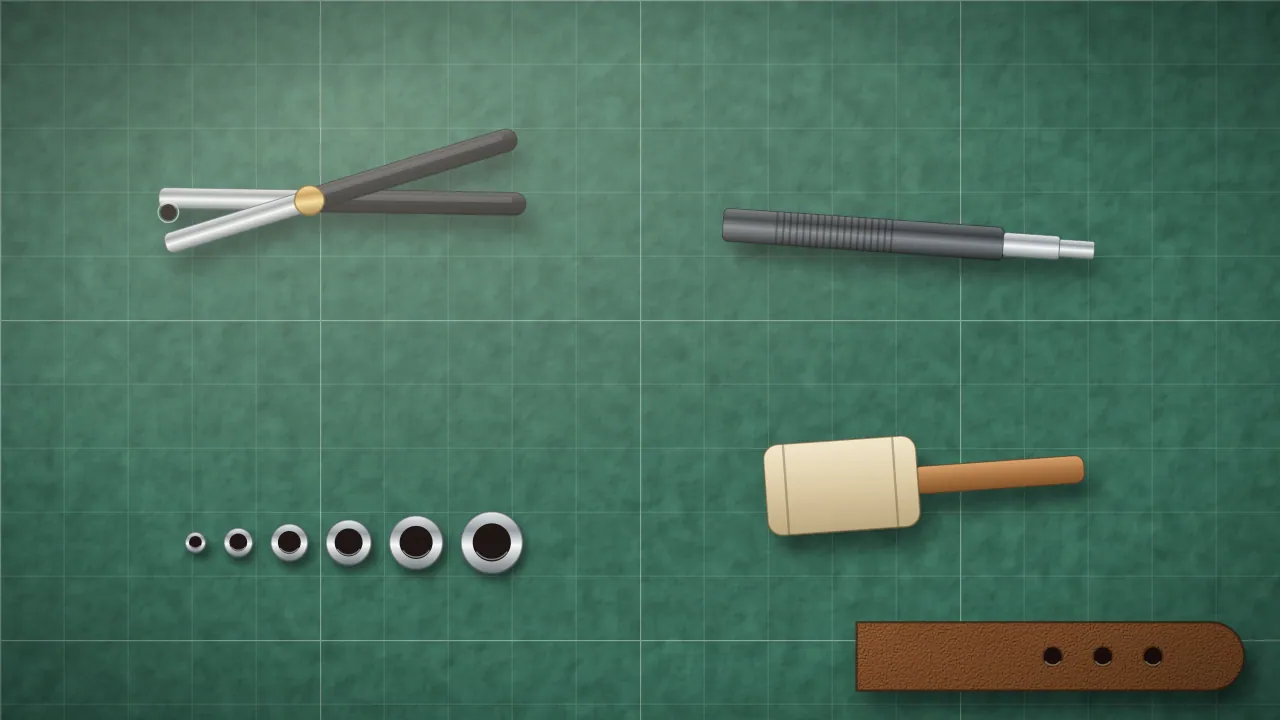
A rotary punch looks like a pair of pliers with a rotating wheel of round tubes in several sizes. You turn the wheel to the size you want, place the leather between the jaws and squeeze. It is one of the most familiar types, often found in household toolboxes for adding a hole to a belt or a watch strap.
Its strengths are speed and convenience near an edge. It needs no mallet and no board, it makes a hole in one squeeze, and the sizes are always at hand on the wheel. For straps, belts and small repairs, it is very practical, as described in how to add a hole to a belt.
Its limits come from its shape. The jaws only reach a few centimetres in from the edge, so it cannot make holes in the middle of a larger piece. Thick or firm leather can need a strong grip, and inexpensive rotary punches sometimes have tubes that do not meet the anvil squarely, which leaves holes not quite cut through. The anvil, a small plate the tubes press against, also wears over time.
Drive punches
A drive punch is a single steel tube with a sharpened end and a head to strike. You place it on the leather, over a hard but slightly yielding board, and strike it with a mallet until it cuts through. Drive punches come in many sizes, and oblong versions make the slotted holes traditional on belts.
They reach anywhere on a piece, cope with thick leather and make very clean holes when sharp, which is why many workshops keep a full set. For thick belt leather in particular, a drive punch struck firmly is often the most reliable tool, a point covered in more detail in punching thick and thin leather.
The price is noise and setup. You need a mallet, preferably a poly, rawhide or wooden one that does not damage the punch head, and a dedicated surface such as a polyethylene board, plus a solid table to absorb the blows. In a flat with neighbours, late in the evening, that can be a real constraint. Holding the punch vertical while striking also takes a little practice.
A few habits make drive punches pleasant to use. Strike with several firm, controlled blows rather than one violent one, and check after each that the tube is still upright. Rotate the punch slightly between blows if the leather is thick, so the cut finishes evenly all round. Clear the plug of leather from the tube regularly, because a jammed tube crushes rather than cuts. And keep the board's surface fresh by turning it or using a different area, since a deep groove from earlier holes lets the tip wander.
Prong punches and pricking irons
For stitching, many makers use tools with a row of teeth that make several holes at once, evenly spaced. Prong punches, sometimes called stitching chisels or diamond punches, are struck through the leather and leave a row of slits ready for the needle. Pricking irons, a more traditional tool, usually mark the leather and pierce it partly, and the holes are then opened one by one with an awl as you sew.
These tools give the regular spacing that makes a hand seam look neat, and the slanted shape of their holes gives the saddle stitch its familiar angle. They come with different numbers of teeth: a single prong for corners and tight curves, two prongs for gentle curves, and longer irons for straight runs. The differences between irons, chisels and awls are explained in our guide to hand stitching leather.
Like drive punches, they are struck, so they need a mallet and a board, and they are loud. They also make only stitching holes; for hardware and belts you still need a round punch. Many makers therefore keep prong punches or irons for seams and a round punch for everything else.
Press punches
A press punch cuts by downward pressure from your hand rather than by a blow. You place the tip on the mark, keep the tool vertical and press firmly until it cuts through, usually on a firm surface. Some designs take interchangeable tips, so one tool covers several hole sizes.
Its main advantages are calm and control. There is no mallet, no loud strike, and you can feel the tip cutting, which makes it easy to stop at the right moment and to keep the tool vertical. Because the hand guides it directly, it reaches anywhere on a piece, not only near an edge. For people who work in shared spaces or simply prefer a quieter bench, punching leather without a mallet explores this way of working.
Its limit is thickness. The force of a hand has limits, so press punches suit leather of small goods and lighter straps better than very thick belt leather. Press punches with interchangeable tips cover the common small sizes in one tool; for heavier leather, a drive punch is the better choice. As with any hand tool, the tip sizes are approximate, so a test hole is always worthwhile, and our article on leather hole sizes explains how to choose.
Choosing for your hands and your projects
The right leather hole punch types depend on three questions. What holes do your projects need: round holes for hardware and belts, rows of stitching holes, or both? How thick is your leather? And how much noise and setup can you accept where you work? A small-goods maker in a flat may be happiest with a press punch and a set of pricking irons used gently; a belt maker with a workshop may rely on drive punches and a heavy mallet.
Many makers end up with more than one type, because each does something the others do not. Start with the one that fits most of your projects, learn it well, keep it sharp and clean, and add the next when a project asks for it. If a press punch fits your projects, our six-tip hole punch has tips from about 1.5 to 4 mm.
Questions people ask
What type of hole punch is best for leather?
It depends on the job. Rotary punches are handy for belts and straps near an edge; drive punches handle thick leather and reach anywhere but need a mallet; prong punches and pricking irons make rows of stitching holes; press punches are quiet and controlled on leather of moderate thickness.
Do rotary punches work on thick leather?
They can struggle. The jaws only reach a short distance from the edge, and thick, firm leather needs a strong grip; some inexpensive rotary punches also leave holes not fully cut. For thick belt leather, a sharp drive punch struck with a mallet is usually more reliable.
What is the difference between a prong punch and a hole punch?
A prong punch has a row of flat or diamond-shaped teeth and makes several stitching slits at once, struck with a mallet. A hole punch makes one round hole at a time, for hardware, belts or round-hole stitching. Most makers use both for different holes.
Can I use a press punch for stitching holes?
Yes, with a small tip. Round stitching holes made with a press punch give a straighter, more upright stitch line than slanted slits. Mark the spacing carefully first, since a single round punch does not space the holes for you as a row of prongs does.
Do I need a special surface for punching leather?
Yes. Use a firm surface the tip can cut into slightly without damage: a polyethylene board, a dense rubber mat or a self-healing cutting mat over a solid table. Hard stone or metal dulls tips; soft surfaces let the leather stretch and give ragged holes.