Making the Holes for a Seam: Pricking Irons, Chisels or an Awl
How a seam looks is decided before the first stitch, when you make its holes. Pricking iron vs stitching chisel vs awl: how each works and which suits you.
Lay two hand-stitched seams side by side and you may notice they look different even when the same thread and the same stitch were used. One has fine, steeply slanted stitches like a row of grains of rice; another has bolder, more upright stitches; a third looks almost like a machine line. Most of that difference comes from the tool used to make the holes before any stitching began. Choosing between a pricking iron, a stitching chisel and an awl is one of the first real decisions in hand stitching, and it shapes both your seams and your evenings at the bench.
This article explains the pricking iron vs stitching chisel question, adds the awl that both families rely on, and covers round holes as a fourth option. It is part of our guide on hand stitching leather, which follows the whole seam from holes to finish.
What each tool does
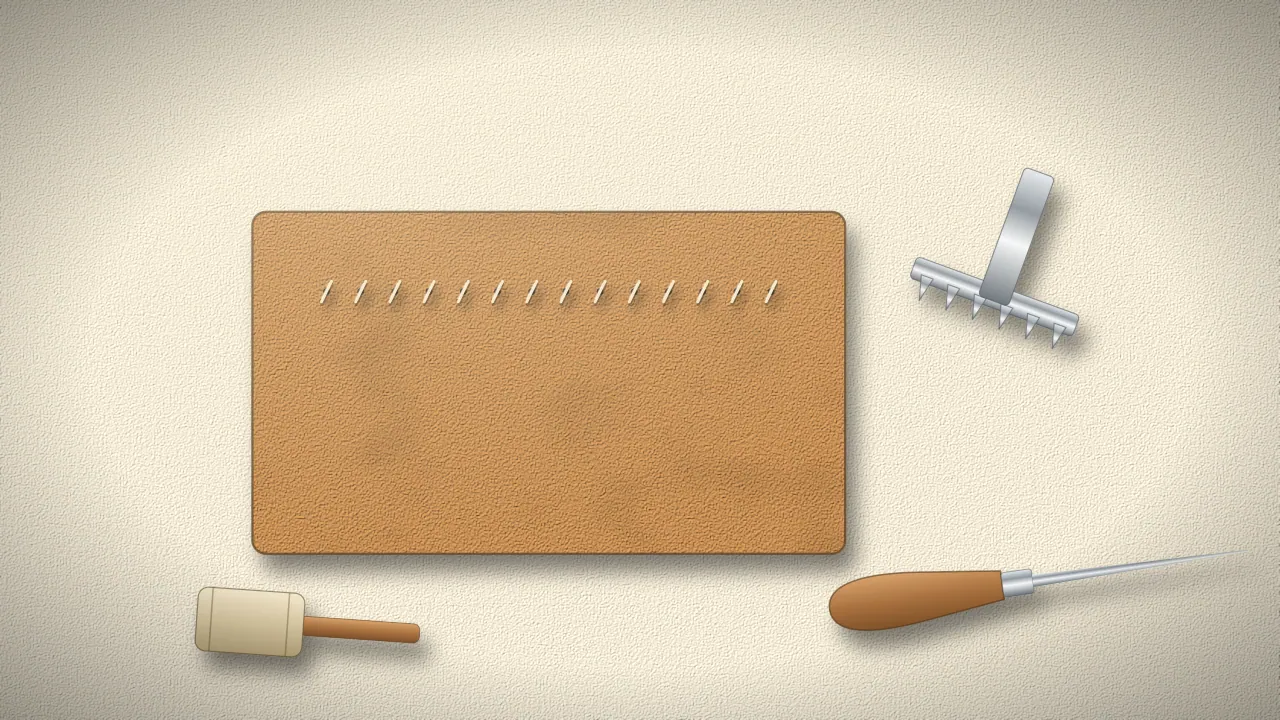
The three tools solve the same problem, making evenly spaced holes along a stitch line, in different ways. A pricking iron has a row of teeth that mark the leather at regular intervals and pierce it partway or lightly through; the holes are then opened with an awl, one at a time, as you stitch. A stitching chisel, sometimes sold as a prong punch or diamond punch, has teeth designed to cut right through the leather when struck, leaving a row of open slits ready for the needle. An awl, on its own, pierces each hole individually.
Pricking irons and stitching chisels both come with different numbers of teeth: one or two for corners and tight curves, four, six or more for straight runs. Both are struck with a mallet onto a firm, slightly yielding board. The spacing between teeth sets the length of your stitches, which is why these tools are usually sold by their spacing, often between about 2.5 and 4 mm; choosing stitch spacing explains how that number changes the look.
The tooth shape matters as much as the spacing. Many modern irons and chisels have diamond-shaped teeth set at an angle, which gives the slanted stitch characteristic of a saddle stitch. Some have flat, straight teeth for a different look. Round holes, made with a punch, give no slant at all.
Pricking irons
Pricking irons are the traditional tool of European saddlery and small leather goods. They mark and partly pierce the leather, and the final hole is made by the awl as you sew, which gives you control over the exact size and angle of each hole. The result, in skilled hands, is a fine, tight seam with a crisp slant, because the awl makes a small, neat hole that the thread fills completely.
That control comes at the cost of time and practice. Opening each hole with an awl, keeping it at the same angle and making sure it exits on the stitch line on the back, is a skill in itself. On thick leather or several layers, the back of the seam can drift if the awl is not held consistently. Many makers love this process for exactly that reason: it makes each stitch deliberate.
Pricking irons are also used gently by some makers simply to mark spacing, followed by a stitching chisel or a round punch to make the actual holes. Whether marked or pierced, the marks they leave must be followed carefully, since every later stitch depends on them.
When using a pricking iron along a line, overlap the last tooth of each strike with the last hole of the previous one, so the spacing stays continuous along the seam. Strike lightly and evenly, keeping the iron vertical, and check that the marks sit exactly on the stitch line before moving on. Near a corner, switch to a two-tooth or single-tooth iron so a mark falls precisely in the corner; adjusting the spacing a little over the last few holes is less visible than a stitch that misses the corner altogether.
Stitching chisels and prong punches
Stitching chisels are designed to go straight through the leather in one strike, leaving open slits. That makes them faster: once the row is struck, you can stitch without stopping to open each hole. The back of the seam follows the front exactly, because each hole was cut in one straight movement, which is reassuring on thicker leather and multiple layers.
The trade-off is that the holes are usually larger and more open than an awl-opened hole, so the stitch can look slightly bolder and the thread has more room. Choosing a thread thick enough to fill the slit, and pulling each stitch with even tension, keeps the seam neat. Our article on why saddle stitches lean explains how the shape of these holes and the order of the needles create the slant.
Prong punches, often sold with one, two, four or six prongs, work in this way: they are struck to punch rows of evenly spaced stitch holes. Like all struck tools they need a mallet and a firm board underneath.
The awl
The awl appears in every approach. With pricking irons, it opens each hole as you sew. With stitching chisels, it helps to re-open a hole that has closed up, to enlarge a hole slightly where layers meet, or to pick up a hole the needle struggles to find. On its own, it can make every hole of a seam, guided by marks from a stitching wheel or dividers.
A diamond awl, with a blade shaped like the teeth of a pricking iron, makes slanted holes that match an iron's look; a round awl makes round holes. Using an awl alone is slow, but it is flexible: it follows any curve, works on any thickness you can push through, and needs no mallet. For small repairs or a short seam, it is all you need.
Hold the awl at the same angle for every hole and push it straight through the stitch line, ideally into a cork or a firm block behind the leather. Keep it sharp and polished; a dull awl tears rather than pierces, and a rough blade drags. The kit's wooden-handled awl is meant for opening and picking up holes and guiding the thread.
Round holes as a fourth option
You can also stitch through small round holes made with a punch. Round holes give a straighter, more upright stitch line, a look some makers prefer for contemporary pieces and that others find too close to a machine seam. They are easy to make precisely, and with a press punch they need no mallet at all, which makes them a quiet option for a flat or late evenings.
The main thing to watch is spacing, since a single round punch does not space the holes for you. Mark the spacing first with a scribing wheel, dividers or a pricking iron used lightly, then punch on each mark. A press punch with a small tip, around 1.5 mm, suits fine stitching. The comparison of round holes and slits is covered in more depth in our guide on how to punch holes in leather.
Whichever method you choose, mark your stitch line first, at an even distance from the edge; stitching grooves and edge distance explains how. The line is what keeps every hole, struck, pierced or punched, in a straight row.
Choosing the holes that suit your seams
The pricking iron vs stitching chisel choice comes down to control versus speed. Pricking irons with an awl give fine, tight, deliberate seams and reward practice; stitching chisels cut through in one strike and let you stitch straight away; an awl alone is slow but goes anywhere; round punched holes are quiet and precise and give an upright stitch.
Try more than one on offcuts, using the same thread and the same stitch, and look at the seams side by side. Your eye will tell you which look you prefer, and your hands which way of working you enjoy. Then follow the seam itself in how to saddle stitch leather. Our starter kit includes prong punches with one, two, four and six prongs and an awl, if you want to try both; a mallet is not included.
Questions people ask
What is the difference between a pricking iron and a stitching chisel?
A pricking iron marks the leather and pierces it partly; each hole is then opened with an awl as you stitch, giving fine, tight seams. A stitching chisel cuts right through in one strike, leaving open slits ready to sew, which is faster but gives slightly larger holes.
Do I need an awl if I use stitching chisels?
It is very helpful. Even with chisels, an awl re-opens holes that have closed, enlarges a hole where layers meet and helps guide the needle. With pricking irons, an awl is essential, because it makes the final hole as you stitch.
What stitch spacing should I choose for my first irons?
A middle spacing, around 3 to 4 mm, suits many small goods and is forgiving to work with. Finer spacing gives delicate seams on small pieces; wider spacing suits thicker leather and bolder looks. Match your thread thickness to the spacing you choose.
Can I stitch leather with round holes?
Yes. Round holes give a straighter, more upright stitch line than slanted slits. Mark the spacing carefully first, then punch on each mark with a small tip. It is a quiet method when done with a press punch, and a matter of taste visually.
Why do my chisel holes look too big?
Chisels cut open slits, and on thin or soft leather they can look large, especially with a fine thread. Use a thread thick enough to fill the holes, consider finer spacing for small goods, and strike only as hard as needed to cut through.