The Blade in Your Hand: Knives for Cutting Leather
A blade that feels right makes every cut calmer and every edge cleaner. Utility, round, head, rotary and skiving: the knife for cutting leather that suits each job.
The knife is the tool you hold most often in leathercraft, and the one whose quality you feel immediately. A good blade glides through the leather with a soft, even sound and leaves an edge you hardly need to touch afterwards; a poor or dull one drags, tears the bottom fibres and makes you press harder than you should. Finding a knife for cutting leather that suits your hand is less about owning the most expensive one than about understanding what each type does well and keeping whichever you choose properly sharp.
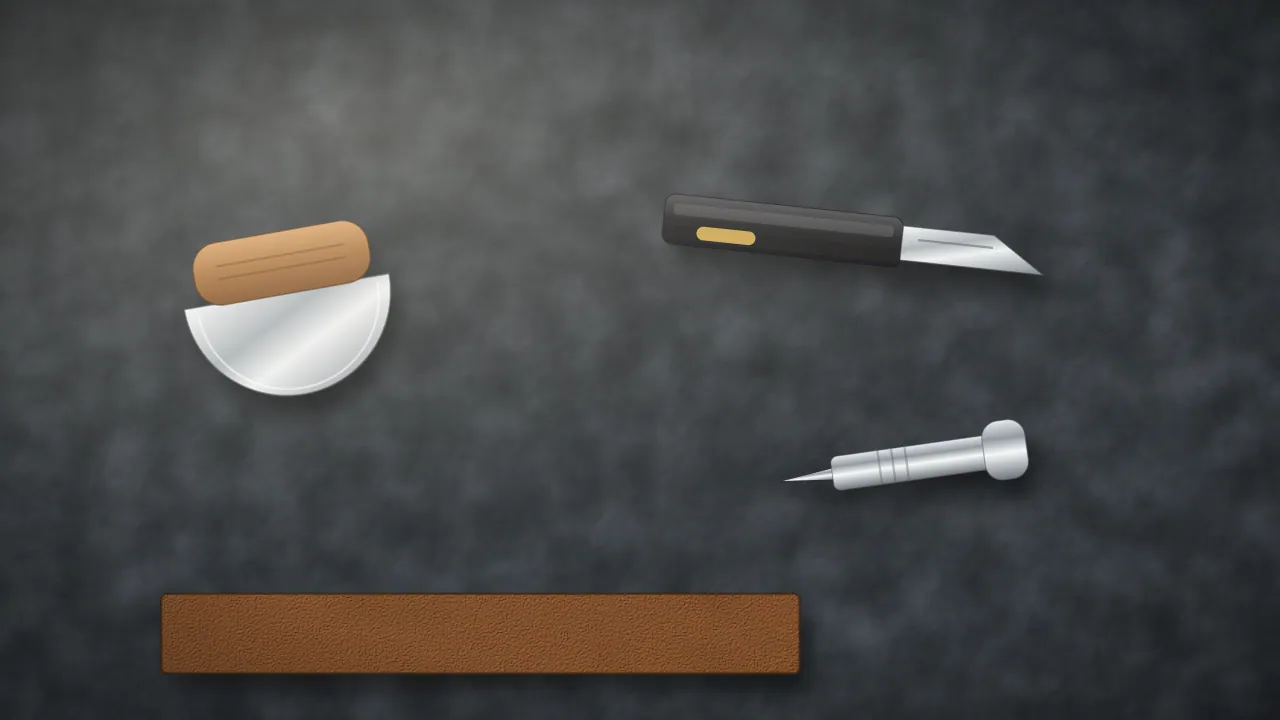
This article compares the knives makers commonly use, utility knives, craft scalpels, round and head knives, rotary cutters and skiving knives, explains what each is good for, and covers sharpening and safety. It is part of our guide to finishing leather edges and surfaces, because every clean edge starts with a clean cut.
Utility knives and craft scalpels
The humble utility knife is where most makers start, and many never stop using one. Its replaceable blades mean you always have a sharp edge available: when the blade starts to drag, you change it in seconds. Trapezoid-blade models are sturdy and hold their blade firmly; snap-off models let you break away a dull section and continue with a fresh tip. Either works well against a steel ruler for straight cuts.
Craft knives and scalpels, with small, thin blades, are useful for detail: tight curves, small cut-outs, the inside of a thumb notch on a card holder. Their blades are fine and flexible, so they are best on thinner leather and for short cuts. A scalpel handle with replaceable surgical-style blades gives a very sharp, precise edge at low cost, though the blades are delicate and should be handled with care.
The main habit with replaceable blades is to replace them early. Many makers keep using a blade long after it has dulled because it still cuts, and then struggle with wandering lines and torn edges. A fresh blade costs very little compared with the leather it protects. Our article on how to cut leather straight explains how to guide it.
Pay attention to the handle as well as the blade. A knife you hold for an hour should fill your hand comfortably without pinching, and a slightly heavier body often feels steadier against a ruler than a light plastic one. A locking mechanism that holds the blade without any wobble matters more than any other feature: a blade that shifts in its housing will drift, however sharp it is.
Round knives and head knives
The round knife, with its broad crescent-shaped blade, is one of the most recognisable tools of traditional leatherwork. It is pushed through the leather rather than drawn, rocking along a curve or a straight line, and in skilled hands it cuts long, smooth lines, follows curves beautifully and can also skive edges thin. The head knife is a close relative, with a half-moon blade and a point at each end.
These knives are versatile and satisfying to use, but they ask for two things: practice and sharpening. A round knife bought new often needs its edge refined before it cuts well, and it must be kept keen with regular stropping. The pushing motion also takes some getting used to, especially on straight cuts against a ruler, where the curved blade has to be held at a consistent angle.
Many makers adopt a round knife once they know they enjoy the craft, and keep a utility knife alongside it for quick jobs. The round knife's broad blade also lets you see the line on both sides of the cut, which many find helpful on curves, and its weight does part of the work for you once the edge is properly keen. If you are curious, try one on offcuts before relying on it for a project, and budget for a strop and compound as well as the knife.
Rotary cutters and clicker knives
Rotary cutters, the rolling-blade tools used by quilters, are handy for long straight cuts on thinner leather, such as straps cut from a hide or linings. They roll along a ruler without dragging and cut cleanly through leather of moderate thickness. On thick or firm leather they can struggle and may need several passes, and their round blades need replacing or sharpening when they start to skip.
Clicker knives, named after the "clicking" trade that cuts shoe parts, are compact handles holding short replaceable blades, often curved. They are designed for cutting around templates by hand, with a comfortable grip for long sessions. Some makers prefer them to utility knives for pattern cutting because the blade angle and the handle feel more natural on curves.
Whatever you use, cut on a self-healing mat, and replace the mat when its surface becomes deeply scored, since old grooves catch blades and steer them off the line. A rotary blade in particular is dulled quickly by hard surfaces, and any blade that hits glass, stone or metal loses its edge in a moment.
Skiving knives and the swivel knife
Two other knives are often mentioned but have different jobs. A skiving knife has a blade set at an angle, designed to shave leather thinner at an edge or along a fold line rather than to cut through it. Skiving is what keeps folds and overlaps from becoming bulky, and it is covered in skiving leather by hand. Safety skivers, with a replaceable blade in a guarded holder, are an easier way to start.
The swivel knife is a carving tool, not a cutting tool. Its small blade turns in a barrel as you guide it, cutting shallow lines into the surface of dampened vegetable-tanned leather for decorative carving. It is not meant to cut through leather, and using it that way damages both the blade and the piece. Our article on swivel knife basics for leather carving explains how it is used.
A swivel knife is for that decorative work and scissors for thread and small pieces; for cutting out shapes and straight edges, most makers use a utility knife, a round knife or a head knife with a steel ruler.
Sharpening, stropping and safety
A sharp knife is safer than a dull one, a phrase every leatherworker hears, and it is true: a sharp blade goes where you guide it with light pressure, while a dull one needs force and slips. For replaceable blades, sharpness means changing them often. For round knives, head knives and fixed blades, it means sharpening on stones when the edge is damaged and stropping regularly on leather loaded with a fine polishing compound to keep it keen.
Stropping is quick once it becomes a habit: a few strokes on each side of the blade, edge trailing, before each session. Many makers strop their round knife every few cuts during a long session. If stropping no longer brings the edge back, it is time to return to the stones.
Safety habits matter as much as sharpness. Cut away from your body and your other hand, keep fingers behind the ruler, cover or retract blades when you put them down, and store knives where they cannot roll off the table or be grabbed by children. Dispose of used blades in a closed container. Our article on trimming and sanding leather edges picks up where the knife leaves off.
If you share your home, think about where knives live between sessions. A closed case, a drawer with a catch or a magnetic strip placed high up keeps blades out of reach, and a habit of retracting or capping a blade the moment you put it down prevents most accidents on a busy table.
Choosing your knife
A knife for cutting leather does not need to be expensive to be good. A sturdy utility knife with fresh blades, a heavy steel ruler and a cutting mat will cut every project in this blog. Add a small craft knife for details, and consider a round knife once you know you love the craft and are ready to learn to sharpen it.
Whatever you choose, keep it sharp, cut in light passes, and practise on offcuts until your strips come out even. The quality of your cut shows in every later step, from the burnished edge to the line of stitches running beside it.
Questions people ask
What is a good knife for cutting leather?
A sturdy utility knife with replaceable blades is a practical and inexpensive choice, especially with a steel ruler and a cutting mat. Many makers later add a round knife or head knife for long cuts and curves, which needs practice and regular stropping.
Can I use a box cutter on leather?
Yes. A good box cutter or utility knife cuts leather well, as long as the blade is fresh and you cut against a steel ruler on a mat. Change the blade as soon as it starts to drag, since a dull blade tears fibres and wanders off the line.
Do I need a round knife for leathercraft?
No. A round knife is a lovely, versatile tool, but a utility knife and a craft knife can cut every first project. If you choose a round knife later, budget time to learn the pushing cut and to keep it sharp with stones and a strop.
How do I keep a leather knife sharp?
For replaceable blades, change them early. For fixed blades, strop them regularly on leather loaded with a fine polishing compound, and sharpen on stones when stropping no longer restores the edge. Always cut on a mat rather than a hard surface.
Can a swivel knife cut through leather?
It is not designed to. A swivel knife cuts shallow decorative lines into the surface of dampened vegetable-tanned leather for carving. Using it to cut through leather damages the blade and gives poor edges; use a utility knife or a round knife instead.